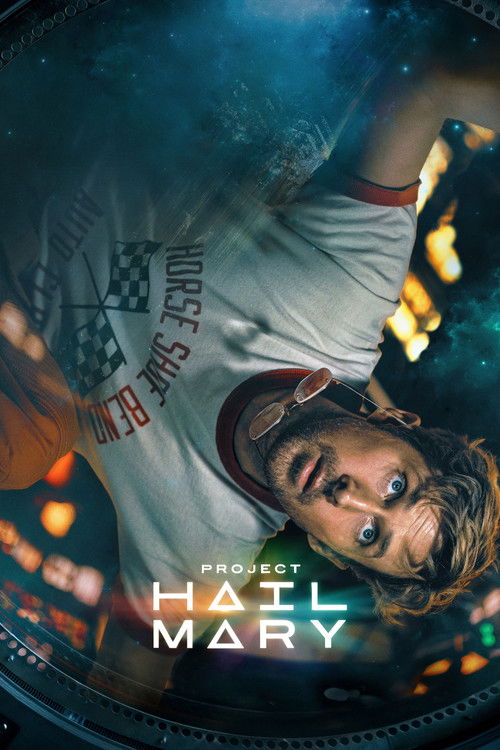
Project Hail Mary: The Manuscript Ryan Gosling Read While Movie Theaters Were Dying
Phil Lord & Chris Miller
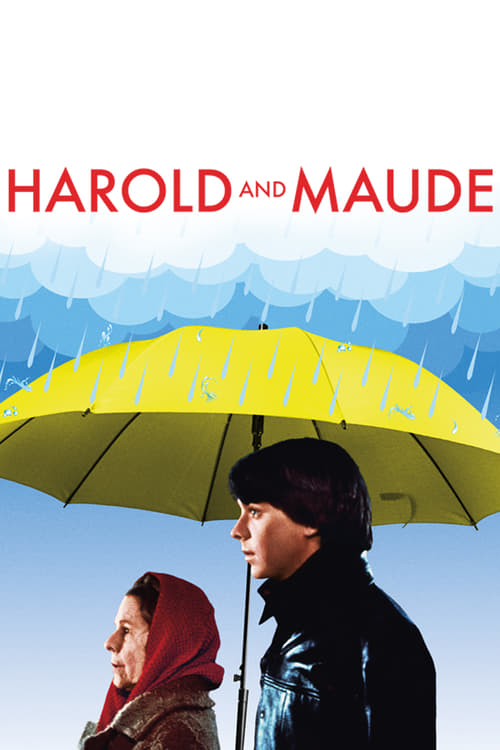
Phil Lord compared his $200 million space epic to Harold and Maude. Not Interstellar. Not Gravity. A morbid '70s romance about a kid who wants to die and an older woman who teaches him how to live. "That's what Maude does to Harold," he said. "It is a little bit what Rocky does to Grace." Once you hear that, you can't unsee it. Project Hail Mary stops being "The Martian with a pet rock" and becomes something much stranger — a film about a man who can only learn how to be human by befriending something utterly inhuman.
That's the real fun of pulling apart this movie. The influences aren't other space films. They're Amblin kids' movies, Hal Ashby, Frank Oz's puppet hands, 747 cockpits, Jump Street improv tricks, and a German stage actress who keeps blowing up scenes by singing karaoke. Lord and Chris Miller didn't stack references on top of Andy Weir's novel. They raided their childhood VHS shelves, their animation careers, and their collaborators' obsessions to build a ship that feels lived in and a friendship that feels earned.
Here are the movies hiding inside that little "coke can" of a spaceship.
Harold teaches Rocky how to love
Lord calls Harold and Maude "really close to our heart" and maps the relationship directly onto Rocky and Grace. He loves that Ashby built a story about an alienated young man who only starts to flourish because someone totally unexpected drags him back into feeling. That's the energy he wanted in a film that, on paper, is about a middle-school science teacher saving the sun.
You feel it every time Project Hail Mary stops being about astrophage and switches to two freaks awkwardly sharing a home. Grace is Harold: numb, guilty, convinced he's already failed everybody. Rocky is Maude: unstoppable, weirdly joyful, seeing potential where Grace only sees shame. Watch the way Rocky barges into Grace's routines, insists on collaboration instead of letting Grace martyr himself. That final choice — giving up Earth to answer Rocky's distress call — plays like Harold's last wild gesture flipped: choosing life by choosing someone else.
Rewatch Harold and Maude and pay attention to how Ashby turns dark jokes and odd rituals into a kind of therapy. That's the trick Lord is stealing for his astronaut-and-rock bromance.
"You're Frank Oz, and I'm making Yoda for you"
That's what creature legend Neal Scanlan told puppeteer James Ortiz when they sat down to build Rocky. Scanlan — trained at the Jim Henson Creature Shop on Labyrinth, now famous for the Star Wars creatures — wasn't treating this as a VFX problem. He was treating it as Dagobah.
Ortiz delivered on that standard. He spent takes literally sprinting through the set inside a "hamster ball," screaming Rocky's lines, or hiding with a Bunraku-style rig so Rocky's reactions could land in real time. He promised Gosling early on: "We can always be improvisational together." No green screen anywhere in the film — not a single frame. Two thousand eighteen VFX shots, every one built on top of something physical.
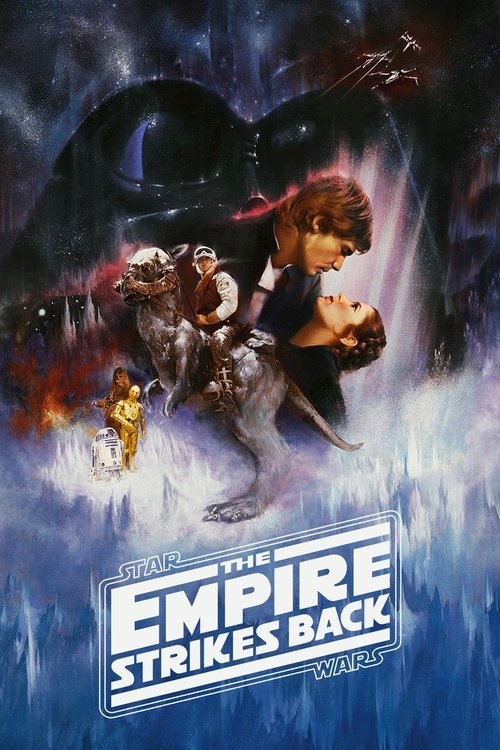
You can see it in the timing. The overlapping dialogue, the little double-takes, the jokes that land slightly off-rhythm — that's two performers riffing, not an A-lister miming at empty air. Cue up The Empire Strikes Back, watch Luke and Yoda in the swamp, and you'll feel the same thing: a real actor playing off a real puppet, both becoming more alive because of it.
The Nostromo's lungs, with better plumbing
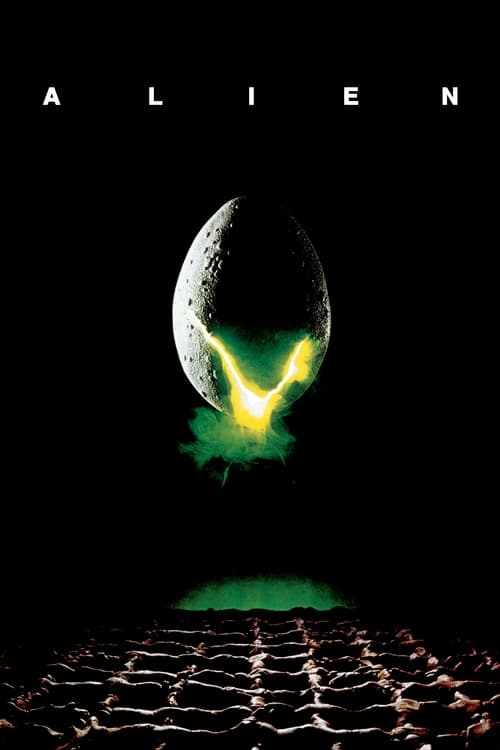
The Hail Mary doesn't look like a glass Apple Store because Greig Fraser brought up Alien. He and Lord loved those dirty, cream-coloured, quilted corridors, and Lord wanted a ship that felt like "a quilt of many different nations" instead of a monolithic sci-fi monolith. The walls around Grace's bunk are literally quilted. Envelopment instead of chrome.
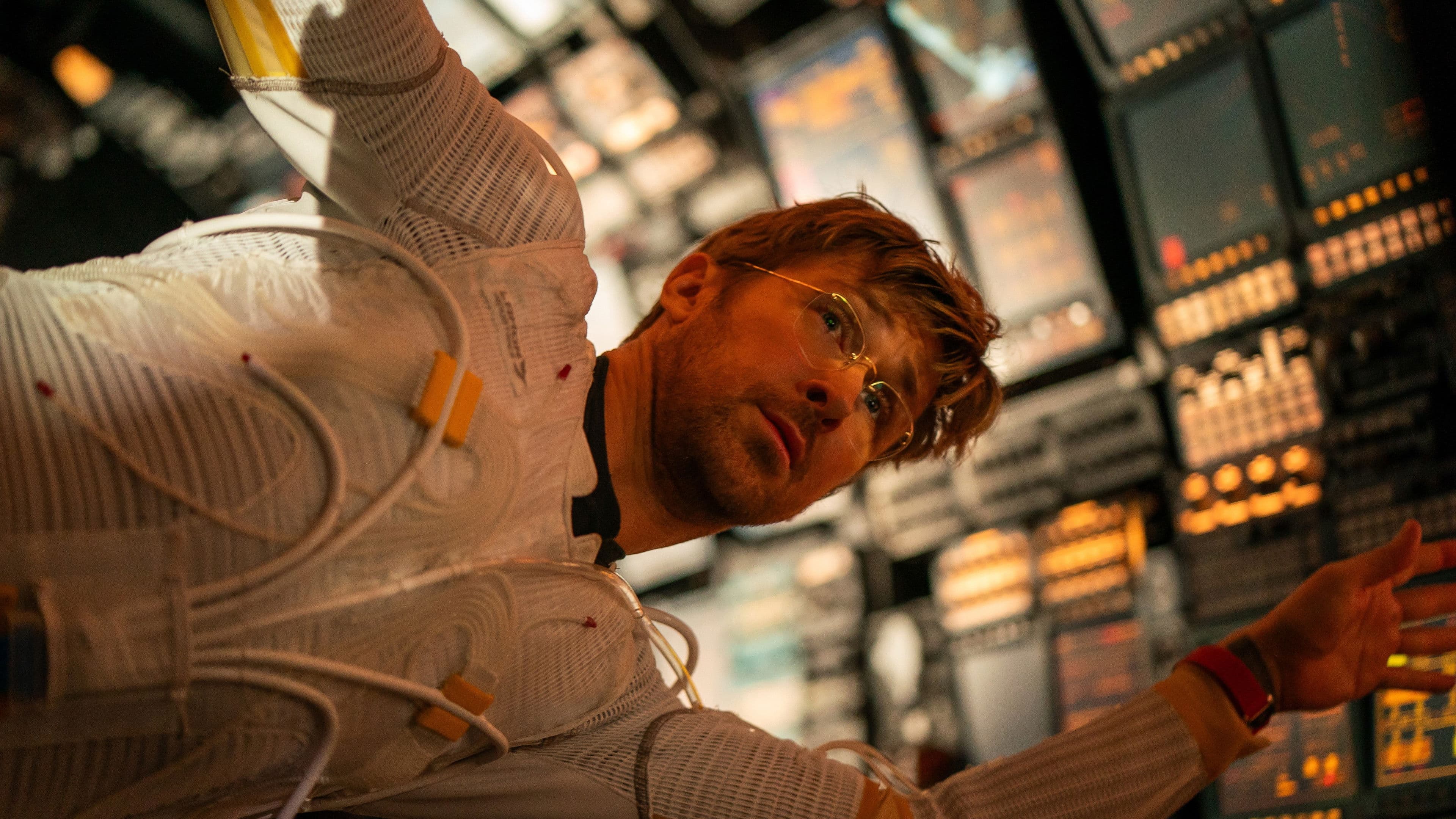
Production designer Charlie Wood grounded that in real engineering. He buried himself in ISS footage, Soyuz modules, and 747-400 cockpits. The result is a cockpit stacked with analog-looking instruments, airline-style windows with visible gaskets, and graphics that are deliberately a bit off — blacks not quite matching, colours slightly inconsistent — because that's how real cockpits look when multiple vendors collide. When the whole set tips on a gimbal, it doesn't feel like CG. It feels like a flying boiler room that might kill you if you hit the wrong toggle.
Throw on Alien and look at the Nostromo's mid-tones and grime. Then watch some ISS footage. You can almost see Lord, Fraser, and Wood cutting those images up and gluing them into one ship.
The total mess who used to be Neil Armstrong
Gosling has been to space before. In First Man, he played Armstrong as sealed, stoic, technically precise — grief compressed into silence. Ryland Grace is the opposite in every way. "All the things I had explored before seemed elegant and effortless," Gosling said. "Now I could really embrace the reality of how I think I would be, which is like a total mess."
That word — mess — unlocks the performance. Grace's comedy comes from panic, not confidence. And the register Gosling pulls from isn't his dramatic history. It's Barbie. It's The Fall Guy. The physical, self-deprecating comedy those roles unlocked is what makes Grace's zero-gravity fumbling feel alive.
Lord spotted something precise about the technique: Gosling "immediately confers status to the other characters in the scene." Watch for it. The handsomest man in the room spends the entire movie looking up at Rocky, trying to impress a puppet. That's the acting choice that makes a human-alien friendship feel earned.
Sandra Hüller sings karaoke (again)
In Toni Erdmann, Hüller delivered one of the most electric scenes of the 2010s: a soul-cracking rendition of Whitney Houston that blew open a character suffocating under corporate control. In Project Hail Mary, she gets another karaoke moment — Harry Styles' "Sign of the Times" — and it does the same thing to Eva Stratt. The iron-willed mission leader lets something slip, just for a moment, through a pop song.
Lord and Miller knew what they had. This is casting that treats a performer's filmography as raw material. Hüller brought something else too — her training at Berlin's Ernst Busch Academy, which fuses Brecht's intellectual distance with Stanislavski's emotional truth. That duality is Eva Stratt: performing authority rather than feeling it, until the singing cracks the surface.
"Not everything always has to be motivated from the inside," Hüller said about what the experience taught her. "Sometimes you can simply assert something, perform." You can see it in Stratt's controlled stillness — which makes the karaoke scene land like a gut punch.
The earpiece from 21 Jump Street
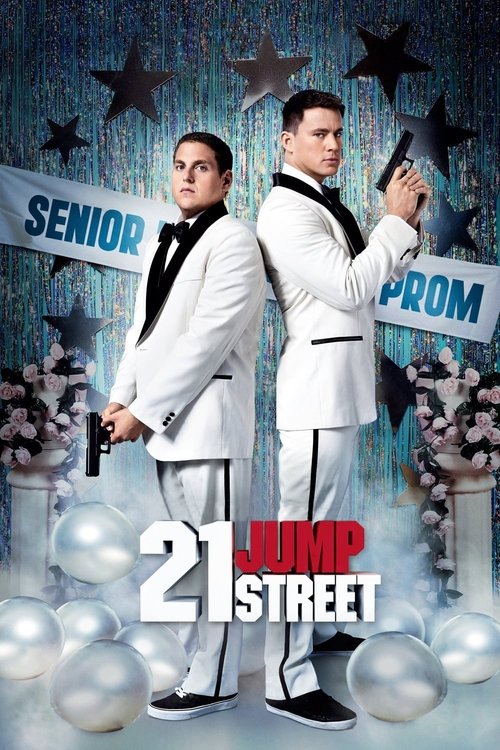
On set, Lord and Miller used the same trick they perfected on 21 Jump Street: whispering new lines into actors' earpieces mid-take so the jokes and reactions feel fresh instead of pre-baked. Gosling loved it. He wanted a way to keep things playful even when he was alone in a tin can. Combined with Ortiz's puppeteering and 40-minute improv takes, the ship became a comedy workshop disguised as a sci-fi set.
That decade of animation and riff-heavy comedies is why Project Hail Mary feels so loose inside such a tight structure. Grace muttering to himself, spiralling into half-jokes, then genuinely freaking out — that's Jump Street energy pointed inward. Every physical gag on the ship (rotating sets, upside-down hatches, Rocky's hamster sphere) lands as character work because Lord and Miller never let a joke exist in a vacuum.
Rewatch 21 Jump Street after Hail Mary and clock the rhythms: the way a sincere moment gets undercut, then somehow lands harder. That's the rhythm they smuggled into a serious space movie.
The E.T. feeling, just with more vacuum
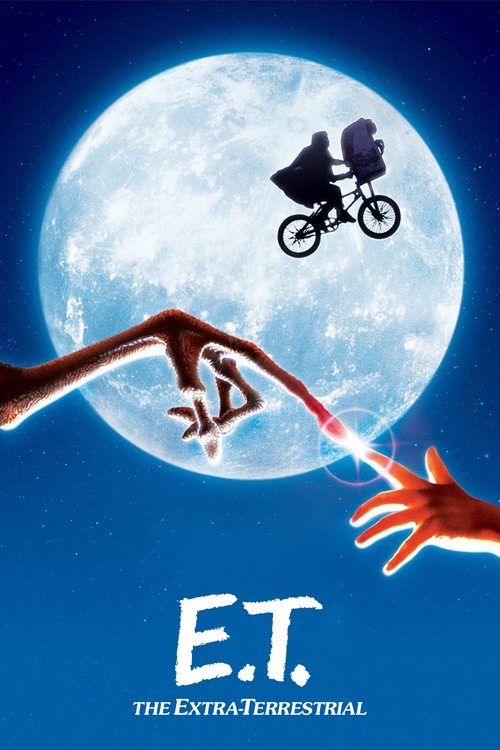
Miller admits there's "certainly an element of E.T. in this film," and you can feel it everywhere. The camera treats Rocky with Spielberg reverence: low angles, gentle push-ins when he's hurt, tiny pauses before punchlines so you register his feelings. When Grace builds the "Don't Go Crazy" room and starts beaming forests and beaches into space, it's Elliott's living room all over again — a human using images to say "this is my world" before he has the words.
There's a Close Encounters quotation in there too. Rocky communicates through musical tones, and the first-contact sequence — two species building a shared language note by note — echoes that five-tone sequence: first contact as translation, solved through curiosity and music. Lord and Miller fold the homage into their own story so naturally you might miss it if you're not looking.
But where Spielberg lets wonder build and build, Lord and Miller pop the balloon — then somehow make the feeling bigger because of the laugh. Go back to E.T. after Hail Mary and notice how much of it is just two beings in small spaces learning each other's rhythms. Lord and Miller are asking: what if you did that, but the shed is an over-engineered NASA sarcophagus and the BMX ramp is the orbit of a dying star?
Put all of this together and you get a picture of how Lord and Miller think. They don't start from genre. They start from things that made them feel something — a '70s romance they saw too young, a puppet that made them cry, the way real cockpits look when nobody designed them to be beautiful. Gosling brought a father's instinct: the need to make something his kids would carry. Hüller brought a stage actress's discipline cracked open by a pop song. Drew Goddard brought his allergy to nihilism — "I'm tired of post-apocalyptic stories for the sake of it." And the whole thing holds together because every collaborator reached for the same idea: impossible things should feel touchable, and touchable things should feel miraculous.
If you want one film before you rewatch Project Hail Mary, make it Harold and Maude. It's the least obvious reference and the most revealing one. Once you've seen Harold learn to live by loving the wrong person, Rocky dragging Grace back into the light looks like the sweetest, strangest remake ever set in space.